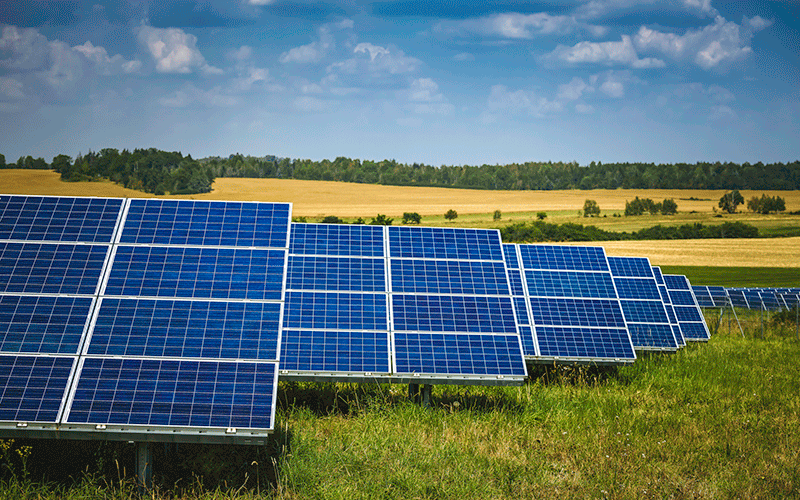
Solar farm – iStock
Planning permission has been granted for the development of a solar farm in Pontlliw, Swansea, as a Development of National Significance (DNS).
The solar farm, plans for which were submitted by Gwenlais Solar Limited in September 2023, will require about 30 hectares of farmland and comprise solar PV panels on mounting systems, substations and transformer buildings, trackways, security fencing and containerised storage facilities.
An objection was put forward by Pontlliw & Tircoed Community Council, based on various concerns, including that the proposal would involve development in the ‘green belt’, the village of Pontlliw risks being ‘flanked’ by solar farms, and the potential destruction of natural habitats.
The inspector appointed to the application, a non-practising solicitor named J P Tudor, found that Swansea Council did not consider the land in question to be in a designated green belt/ wedge area and that the visual and ecological impact of the proposal would be limited.
Swansea Council raised concerns that baseline ecological conditions had not been sufficiently assessed, meaning it could not properly establish whether the development would negatively impact upon ecology or whether a net benefit for biodiversity would be achieved. The inspector disagreed, however, finding the applicant’s ecological reports to be sufficient, while also finding measures such as the planting of shrubs and hedgerows to be satisfactory in increasing the diversity, extent and value of habitats when compared with baseline conditions.
Summarising their decision, the inspector highlighted the Welsh Government’s “strong support for the principle of developing renewable and low-carbon energy from all technologies and at all scales to meet Wales’s future energy needs. It states that, in determining planning applications for renewable and low-carbon energy development, decision-makers must give significant weight to the need to meet Wales’s international commitments and to the target of generating 70 per cent of consumed electricity by renewable means by 2030 in order to combat the climate emergency”.
A climate emergency was formally declared by both the Welsh Government and Swansea Council in 2019 “in recognition of the climate crisis and the need to tackle it through collective action,” the report explains, and this particular development is said to have capacity to “generate around 16MW of electricity, enough to power 4,900 homes per year, which would be a meaningful contribution towards meeting those national policy objectives”.